Romanée-Conti (DRC): Resale Value, Condition and Authentication
Domaine de la Romanée-Conti (DRC) is one of the most recognised names in fine wine. Collectors value its wines for their sites, scarcity and histo...

In This Article
The Three Pillars of DRC's Collectibility
Romanée-Conti is sometimes discussed alongside scarce luxury goods from names such as LVMH and Hermès, or even compared with shares in companies such as Apple. That analogy describes prestige and demand; wine is not an equity, and the source provides no like-for-like performance evidence.
1. Exceptional Terroir: A Tiny Grand Cru Monopole
A wine's identity begins with terroir. DRC's flagship, the Romanée-Conti Grand Cru vineyard, sits at the centre of the domaine's reputation.
- Exceptionally small: Romanée-Conti covers only 1.81 hectares, less than the area of two standard football pitches. That compact site necessarily limits production.
- Sole ownership: it is a monopole owned by the domaine, so only Domaine de la Romanée-Conti can produce wine under the Romanée-Conti Grand Cru name.
- A distinctive site: the vineyard lies in the heart of Vosne-Romanée in Burgundy's Côte de Nuits. Its easterly exposure and well-drained limestone soils, with a proportion of clay, support Pinot Noir of concentration and long ageing potential. The domaine's current official portfolio lists nine grands crus. The source's older count of eight did not include the later-added Corton-Charlemagne, whose official page lists 2019 as its first harvested vintage; the source gives the overall vineyard area as roughly 25 hectares.
2. Severe Scarcity: Limited Supply for Global Demand
Low production is one important reason for Romanée-Conti's high market price.
The Romanée-Conti vineyard produces, on average, only about 5,000–6,000 bottles a year. By comparison, a leading Bordeaux estate such as Lafite (Château Lafite Rothschild) may produce more than 200,000 bottles annually. The source gives a striking vintage comparison: 454 cases of Romanée-Conti in 2020 versus 105 cases after the frost-affected 2021 season, less than one-quarter as much. These figures describe two releases and should not be treated as a fixed annual pattern. The domaine's allocation system is also described as requiring buyers to take other wines with Romanée-Conti, which further limits the number of standalone bottles reaching the secondary market.

3. A Winemaking Philosophy Centred on the Land
DRC's stated ideal is to let the grapes express the site. In practice, that means detailed vineyard work, strict selection and restrained handling in the cellar.
- Biodynamic practice: the domaine has long used organic and biodynamic methods to support soil and vine health. Describing this as a complete absence of every chemical input would require vintage-specific estate records, so the relevant point here is its documented commitment to those farming principles.
- Old vines and low yields: the source describes many vines as more than 50 years old and naturally low yielding, with the fruit of roughly three vines required for one bottle.
- Detailed vinification: grapes are sorted by hand, and the wine is moved by gravity into 100% new French oak for a reported 15–18 months of maturation. The combination is associated with concentrated fruit, fine tannins and a supple texture, although expression varies by vineyard and vintage.
DRC Red Wines: Historical Resale References in Hong Kong Dollars
Resale indications for DRC wines vary widely by cuvée, vintage, bottle size, provenance and condition. Dibao Wine reproduces the source table below using its approximate conversion rate of RMB1 ≈ HK$1.08. The figures are source-era references for 750 ml bottles, not live purchase offers; any actual assessment depends on current demand and the bottle's condition.
| DRC Wine (Grand Cru) | Source's International Average (RMB) | Approximate Source-Era Reference (HKD) | Style and Position in the Portfolio |
|---|---|---|---|
| Romanée-Conti Grand Cru | ¥ 113,938 | Approx. HK$123,053 | The flagship monopole: complete and spherical ("spheric" in the source), finely detailed and reserved in style, with exceptional ageing potential. Prestige does not determine the value of a particular bottle. |
| La Tâche Grand Cru Monopole | ¥ 27,710 | Approx. HK$29,927 | A monopole and DRC's largest single holding. Often described as dramatically floral and expansive; some collectors regard it as a comparatively accessible route into the upper tier of DRC. |
| Richebourg Grand Cru | ¥ 16,833 | Approx. HK$18,180 | Rich, full and broadly structured. Burgundy critics have described it as one of the domaine's most opulent, powerful wines. |
| Romanée-Saint-Vivant Grand Cru | ¥ 13,538 | Approx. HK$14,621 | Elegant, refined and ethereal in style. The source describes DRC as holding the vineyard's largest parcel, 5.28 hectares. |
| Grands Echézeaux Grand Cru | ¥ 13,591 | Approx. HK$14,678 | Firmly built and composed, and often positioned as a step up in concentration from Echezeaux. |
| Echézeaux Grand Cru | ¥ 12,225 | Approx. HK$13,103 | Often treated as an entry point to DRC's grands crus, with a relatively lighter, earlier-drinking profile and red-fruit, wild-herb and undergrowth notes. |
| Corton Grand Cru | ¥ 9,609 | Approx. HK$10,378 | A red-wine grand cru leased by DRC since 2009, typically deep and firmly structured. |
DRC White Wine: The Rarity of Montrachet
DRC's Montrachet Grand Cru is widely regarded as one of the world's great white wines and is exceptionally scarce, with reported annual production of roughly 3,000 bottles. Its market price can exceed that of many of the domaine's reds. For the rare 1996 vintage, the source gives an approximate market reference of HK$160,000 - HK$200,000; this is an undated historical indication, not a current quotation.
Romanée-Conti vs La Tâche: A Question of Style and Relative Price
Some experienced drinkers prefer La Tâche to Romanée-Conti and consider it the stronger relative value within DRC. That remains a matter of palate, vintage and price rather than an objective ranking.

- Style: La Tâche is often described in three stages: complex floral aromas, generous fruit, then a mineral and spicy finish. Its more demonstrative style can stand out in comparative tastings. Young Romanée-Conti is generally quieter and more inward, rewarding close attention rather than immediate impact.
- Development in bottle: La Tâche may appear more expressive when young, especially during its first 15 years, while Romanée-Conti is often expected to reveal greater nuance after longer ageing. Storage history and bottle variation can matter as much as the general curve.
- Production and price: the source places La Tâche production at roughly four times Romanée-Conti, approximately 18,000–20,000 bottles, and its price at around one-quarter of Romanée-Conti's. Those are broad historical ratios, not a live offer; they explain why some collectors see La Tâche as a relatively attainable expression of top-tier DRC.
Four Factors That Shape a DRC Resale Assessment
When reviewing a DRC collection, Dibao Wine examines four connected factors. None establishes a price on its own:
1. Vintage Reputation and Current Demand
Vintage reputation is an important starting point. Years such as 1945, 1990, 1999 and 2005 are often sought for their quality and longevity. The source states that a Romanée-Conti index rose by a cumulative 285% over the preceding ten years, but it gives no index definition or as-of date here. The figure should therefore be read only as a source-era claim, not as current performance evidence or a forecast.
Two historical auction results illustrate the exceptional upper end of the market:
- A bottle of 1945 Romanée-Conti sold at Sotheby's in 2018 for US$558,000 (about HK$4.38 million), then a world auction record for a single bottle of wine.
- The source also reports that a 12-bottle case of 1988 DRC red wine sold at Christie's in London for £264,000, described at the time as a European wine-auction record.
A well-regarded vintage may attract more demand, but no sale timing can establish a maximum return in advance. Current bids, fees, provenance and condition must all be checked.
2. Bottle Condition and Ullage
For mature wine, visible condition can materially affect both buyer confidence and price.
- Ullage: a buyer checks the liquid level. A high fill into the neck is generally preferred; a lower level may indicate evaporation or seal failure and can raise concern about the wine's condition.
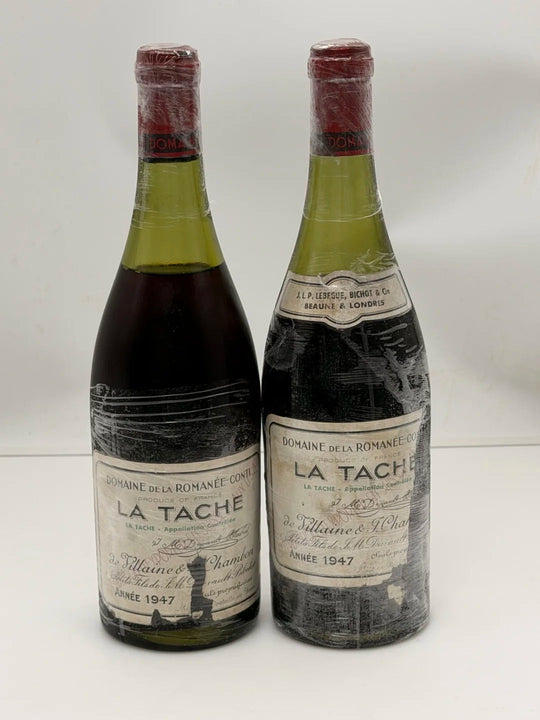
- Label: the label should be photographed clearly and assessed for staining, tears, print details and consistency with the vintage. DRC labels may carry an individual number and a signature, but label features vary and no single feature proves authenticity.
- Capsule: the capsule should appear original and intact. Damage, corrosion, seepage or signs of disturbance require closer inspection; an intact capsule alone does not prove that the contents are genuine.
3. Provenance and Traceability
Clear, credible ownership and storage records can materially strengthen confidence in a rare bottle.
Evidence of stable temperature-controlled storage, together with an original wooden case (OWC), purchase invoice or reputable merchant documentation, helps a buyer reconstruct provenance. It reduces uncertainty but cannot eliminate authenticity or condition risk.
4. Authentication: Learning from the "Dr Conti" Case
DRC is a frequent target for counterfeiters. Rudy Kurniawan, nicknamed "Dr Conti", was convicted in the United States for a large rare-wine fraud involving counterfeit labels and bottles, including DRC names. Public records support the scale and seriousness of his scheme, but the exact number of his fakes still circulating cannot be established bottle by bottle. The source also links wine fraud broadly with other criminal trades; that wider association is not treated here as proof about any particular bottle or seller.

Dibao Wine authentication: a serious review compares typography, microprint, security features, signatures, cork, capsule, glass and provenance against known vintage references. The source notes that La Tâche labels use the circumflex in "Tâche" from 1978 onward; an unexpected spelling deserves closer review, but it is not a standalone authenticity test. Dibao Wine provides an evidence-based assessment, not an infallible or "authoritative" warranty.
Another Route: Less Obvious Value in Burgundy Terroir
Romanée-Conti may represent one summit of Burgundy, but the region's interest extends to quieter domaines with their own sites and farming philosophies. Collectors seeking variety can study these producers on their own terms rather than assuming that obscurity predicts future appreciation.
Prices for small elite domaines in the Côte de Nuits have risen sharply, while some grower wines from the Côte de Beaune may still offer a more accessible drinking experience. "Value" here is a matter of price, provenance and personal taste, not a promised market gain.
1. An Independent Voice in Beaune: Domaine Jean-Claude Rateau
The source presents Jean-Claude Rateau as a notably independent grower in the Beaune appellation and an early Burgundy practitioner of biodynamics, committed to natural farming for roughly four decades. The claim that he was the region's first biodynamic winemaker is retained as the source's description rather than stated as a verified universal first.
For example, Jean-Claude Rateau Beaune Clos des Mariages Rouge 2022 is a 2022 Beaune village red from a vineyard whose name is associated with a meeting place for young couples. The source describes a ruby colour, delicate fragrance, a smooth and elegant palate, good depth and balance, and potential to develop. It gives the wine a score of 9.8/10 and a price of HK$2,700 (converted from the source's New Taiwan dollar figure); both are source-era references.
2. Northern Pinot Noir: Domaine Richoux
Irancy is a northerly Burgundy village appellation for red wine. It is less famous than the Côte de Nuits but has a distinct style and can be more accessible in price. Domaine Richoux is one of the village's recognised producers, has practised biodynamic farming for years and received Demeter certification in 2021, according to the source.
To apply the valuation framework in this DRC guide to an actual collection, prepare the vintages, bottle count, fill levels and clear photographs of the labels, capsules and packaging, then use WhatsApp 96737259 to request an initial review.
Dibao Wine: A Partner for Reviewing Rare Bottles
Contact Dibao Wine to Discuss Your Collection
Dibao Wine: clear evidence, careful authentication and a market-based quotation.
Send clear bottle details and photographs for a transparent review. Timing and any offer depend on the evidence and current demand.
Further Romanée-Conti Valuation References
- A companion vineyard guide: Romanée-Saint-Vivant, elegance and secondary-market context – Adds vintage, condition and demand factors relevant to DRC bottles.
- A vintage-specific comparison for this guide: 1990 DRC Romanée-Conti after thirty-six years – Helps distinguish one documented bottle and vintage from general Romanée-Conti market claims.
- A related case study: sequentially numbered Romanée-Conti 2009 and 2014 bottles and their handover – A useful cross-reference when reviewing a Burgundy collection.
- Additional bottle evidence: a documented handover of rare wines including DRC Romanée-Conti – Adds a completed case study to the broader market framework.
Send label, vintage, volume, capsule and fill-level photos. Di Bao Wine will review the visible condition and current demand.