Château Margaux 1983-2015: Vintage and Buyback Guide
Bordeaux First Growths remain central to fine-wine collecting. This guide reviews Château Margaux vintages from 1983-2015, using source-reported pr...

In This Article
Within fine-wine collecting, Bordeaux's five First Growths remain important for price visibility and market circulation. Dibao Wine has observed in its buyback work that the estate(Château Margaux) combines a distinctive, elegant style with centuries of recognition. These qualities support international demand, including in Asia, but a bottle's executable value still depends on vintage, provenance and condition.
In 2026, after a broad fine-wine correction, owners of Château Margaux from 1983-2015 may wish to review rather than assume the value of their cellar. This guide explains the source's secondary-market price framework and the condition evidence required for a current quotation; it does not declare a universally best time to sell.
1. Château Margaux: Terroir, Style and Market Recognition
Château Margaux's position was formalised in the 1855 classification prepared for the Paris Exposition Universelle. The estate's official history records that it was the only property to receive 20 out of 20. Its deep gravel drains freely and encourages roots to descend more than 23 feet in search of water, a feature associated with finesse and mineral expression.
The Grand Vin is usually led by Cabernet Sauvignon, supported by Merlot, Cabernet Franc and Petit Verdot. Mature bottles can show violet, cedar and blackcurrant notes. The Chinese source interprets the estate's ageing profile and shrinking stock as support for long-term prices; this remains a market thesis, not an assured upward curve.

2. Selected Vintage Matrix, 1983-2015
Critic scores, historical price movement and current liquidity can all inform a valuation. The table preserves the Chinese source's selected Château Margaux vintages from 1983-2015 and uses its stated exchange rate of about USD 1 = HKD 7.8. Prices remain indicative and require current verification.
| Vintage | Critic score (out of 100) | Source's historical description | International reference (12-bottle case/USD) | Approximate HKD reference | Source's liquidity assessment |
|---|---|---|---|---|---|
| 1983 | 98-99 | A landmark revival vintage that can surpass 1982 at Margaux; Paul Pontallier's first vintage at the estate | $9,000 - $9,600 | $70,200 - $74,880 | Very high (described as near peak maturity) |
| 1990 | 100 | A celebrated vintage combining richness and power | $12,660 | $98,748 | High (high-value transaction focus) |
| 1996 | 100 | A strong Left Bank Cabernet Sauvignon vintage with precise structure | $8,767 | $68,382 | Medium-high (good source-reported liquidity) |
| 2000 | 100 | A millennium vintage and modern Margaux reference point | $9,100 | $70,980 | High (frequently traded according to the source) |
| 2005 | 100 | An excellent growing season and long ageing horizon | $8,715 | $67,977 | Medium (compare continued storage with a partial sale) |
| 2009 | 100 | Warm and dry, with a generous modern style | $9,278 | $72,368 | Medium (steady source-reported Asian demand) |
| 2010 | 100 | Large-scaled and highly rated, with a long ageing horizon | $7,040 | $54,912 | Medium-high (source describes early recovery) |
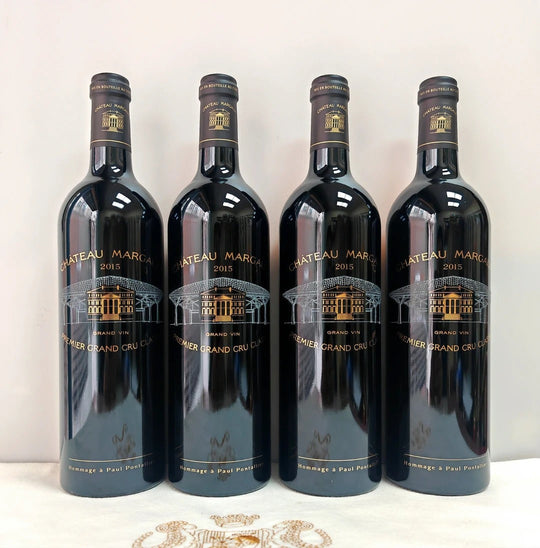
| 2015 | 100 | Commemorative black-and-gold presentation; Paul Pontallier's final vintage | $10,050 | $78,390 | Very high (special-presentation premium may apply) |
Note: the figures are approximate international secondary-market references for original wooden cases (OWC). An actual buyback price depends on storage, ullage, label and capsule condition, provenance and live demand.
1. 1983: A Distinctive Margaux Vintage at Maturity
Although 1982 is celebrated across Bordeaux, the source argues that Margaux's 1983 conditions were especially successful, including low August rainfall and strong phenolic ripeness. It was also Paul Pontallier's first vintage at the estate. Now mature, the wine can show violet, cedar, leather and forest-floor notes. Remaining supply has declined with consumption, but whether to sell depends on the bottle's condition and the current bid rather than a presumed golden moment.

2. 1990 and 1996: Closely Followed Auction Vintages
The warm, early 1990 season produced a generous wine with velvety texture and complexity. The 1996 is a more classically Cabernet-led vintage with linear structure and deep aromatics. Both attract restaurant and collector interest, although their liquidity and value remain price- and condition-dependent.

3. 2000 and 2005: Millennium Recognition and a Long Ageing Horizon
The 2000 vintage combines wine quality with the millennium date and appears frequently in auction catalogues. The 2005 benefited from a strong growing season with sunny days and cool nights, producing concentration and a long ageing horizon. The source presents both as portfolio anchors; an owner should compare actual bids with storage costs and personal needs instead of assuming a large return.

4. 2015: A Commemorative Bottle and Paul Pontallier's Final Vintage
The 2015 vintage marked 200 years of Château Margaux's architecture and the inauguration of new buildings, and it was Paul Pontallier's final vintage. The estate created a one-off black-and-gold screen-printed bottle carrying the words 'Hommage à Paul Pontallier'. James Suckling awarded 100 points. This combination of presentation, history and rating can attract a premium, but neither the score nor the special bottle fixes a resale profit.

3. Physical Factors That Determine a Margaux Offer
Vintage and scores help establish an upper range, while the individual bottle's condition and provenance determine whether that range is achievable. Dibao Wine reviews the following three physical dimensions when assessing Château Margaux.
4. The 2026 Fine-Wine Market: Uneven Stabilisation
The Chinese source describes a strong rebound after two years of correction and renewed safe-haven demand during inflation and geopolitical uncertainty. Liv-ex's official Q1 2026 review is more cautious: major indices were broadly stable before renewed weakness in March. Fine wine can have different return drivers from public markets, but it remains exposed to inflation and downside risk.
Hong Kong's zero wine duty supports its role as an international trading hub. The source also describes cultural demand in Asia for Margaux's elegant style. These factors can broaden the buyer pool, but they do not set a floor price or a higher net return than another market.

5. Dibao Wine: Condition-Led Assessment for Château Margaux
Selling mature Margaux requires current market evidence and a careful review of the exact bottles. Dibao Wine assesses leading international wines, including Bordeaux First Growths and Burgundy estates such as DRC and Leroy . Appointment, collection and settlement options are confirmed for each accepted transaction in Hong Kong, Macau or Taiwan.
Does your cellar include one of these Château Margaux vintages? Request a current, non-binding valuation before deciding whether to sell.
To apply this 1983-2015 Margaux guide to an actual collection, record the vintage, bottle count, fill level and label condition, then use WhatsApp 96737259 to request a preliminary valuation.
Dibao Wine— using condition, provenance and market evidence to assess mature wine.
Further Reading on Bordeaux Collections
- Related case study from the guide's 19xx vintage range: Four Bottles of Château Margaux 2000 in Hong Kong — adds vintage, condition and buyer-demand context for Margaux.
- Margaux comparison from the guide's 19xx vintage range: A Château Margaux 2000 Collection Changes Hands — compares different Margaux bottles in the secondary market.
- Regional reference: Château Margaux—Secondary-Market Pricing from 1983 to 2015 — provides another cross-check for a Bordeaux valuation.
- Valuation link from the guide's 19xx vintage range: Beyond Perfect Scores—Which Margaux Vintages Draw Hong Kong Demand? — adds market logic to the case studies.
Send label, vintage, volume, capsule and fill-level photos. Di Bao Wine will review the visible condition and current demand.